


Ed Ferguson, Nova Cabinets
Sep 8
8 min read
Updated: Sep 9
This months Feature Creative, Curator, and Craftsmen

There is a lot more to cabinetry than what you see on the outside.
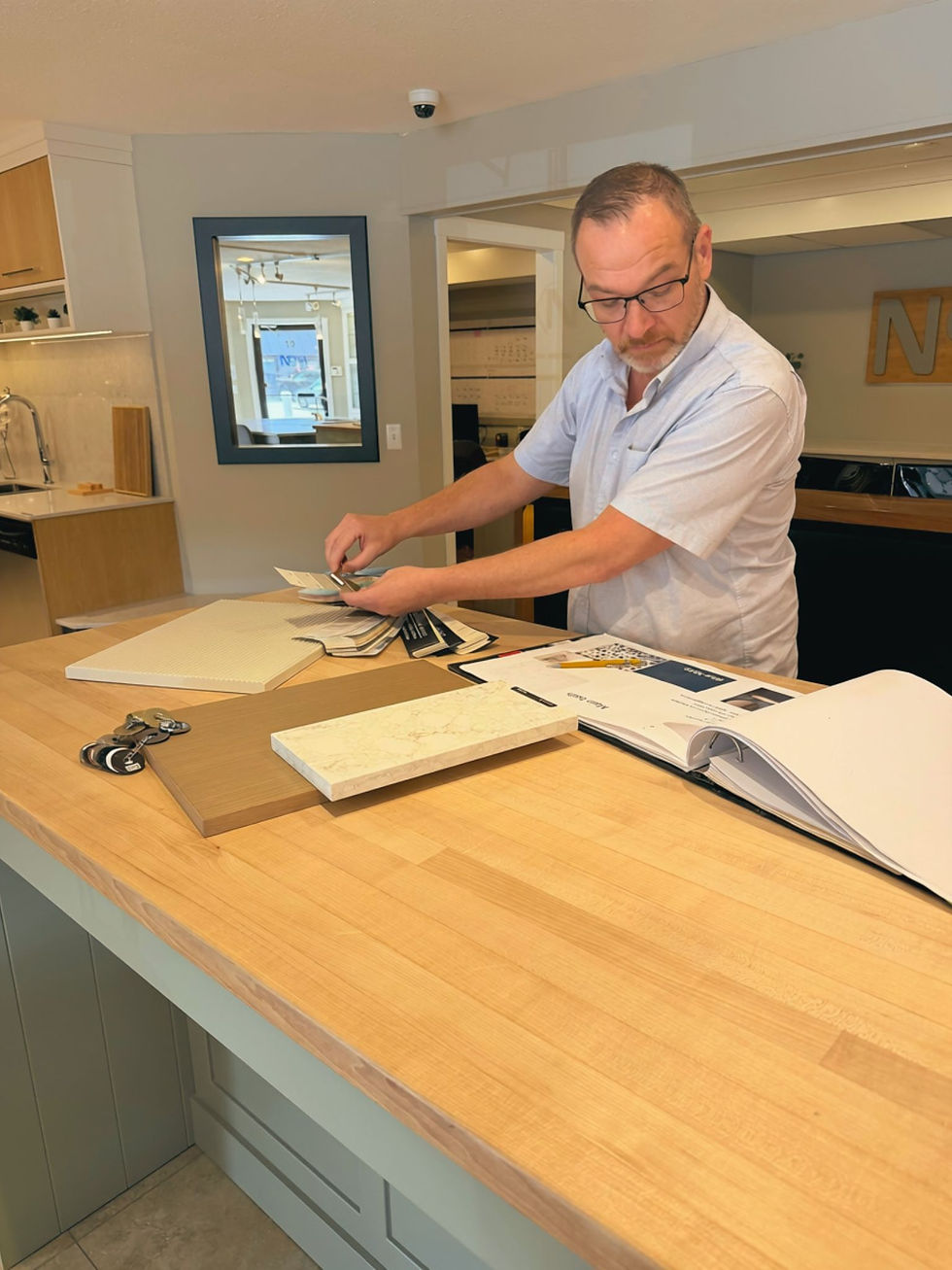
Behind every beautiful kitchen is a series of decisions about proportion, materials, hardware, clearances, traffic flow and, ultimately, how the people living there will use the space every day. For Ed at Nova Cabinets, millwork design is where creativity meets the practical realities of how a home comes together.
Originally from Ontario, Ed spent time living in downtown Montreal before making his way to Abbotsford in 2015. With an extensive background in Hospitality Management and Interior Design, he found his way into millwork design after moving to BC.
What drew him to cabinetry was the challenge.
“Every project is a unique puzzle,” he explains. “Design concepts and real-world physics do not always align, so figuring out how to make both worlds work together can bring some intuitive imagination.”
And that combination of creativity and problem-solving is still what keeps him interested today.

For Ed, what he loves most about the work is actually quite simple: he loves the design world.
He enjoys working closely with his clients and the friendships that often come from those relationships. After years in the industry, it’s the people and the constant evolution of design that continue to keep things interesting.
“Nothing ever stays the same,” he says. “The design industry is a big wheel that keeps turning, always showing a new face.”
His clients are also a major source of inspiration. Often, they come to him with a general idea of what they want to achieve, and through conversation, that idea begins to take shape.
“After a little bit of conversation, it allows me to look through their eyes and follow the path I’ve been led to.”
For Ed, inspiration doesn’t necessarily have to come from somewhere grand.
“Inspiration can be found in a simple piece of wood, if you look hard enough.”
Experimenting with new materials and finishes is another way he keeps that sense of curiosity alive.

What Makes a Kitchen Truly Functional?
When it comes to a truly well-designed kitchen, Ed believes there is much more to consider than aesthetics.
For a millwork designer, success means creating a functional space that will continue to serve the people living in it for many years.
“We see spatial recognition and the mechanical engineering that brought everything to life, as well as the beauty of the final product.”
That starts with choosing materials that are appropriate for the environment and support the overall design concept of the property.
Because millwork goes much deeper than the face of the cabinet.
The finished kitchen may be what catches your eye, but behind it is a carefully considered system designed to function properly, withstand daily use and work within the architecture of the home.

How Do You Create a Kitchen That Won’t Feel Dated?
Trends, by their nature, are designed for a specific moment.
Timeless design is different.
For Ed, creating cabinetry that will stand the test of time means keeping the core of the millwork within typical standards, using high-quality hardware and choosing transitional finishes that can evolve with the home.
The beauty of this approach is that the overall aesthetic can be refreshed without replacing the cabinetry itself.
“Timeless cabinetry can be inserted into any setting and adjusted with the finishing touches of the hardware and accessories.”
Changing cabinet pulls, lighting or accessories can completely shift the feeling of a space while the foundation remains intact.
It’s a way of designing for longevity without making a home feel stuck in one particular moment.

The Details Homeowners Don’t Think About Until It’s Too Late
First comes function.
When Ed begins planning a kitchen, colour isn’t the first thing he considers.
The goal is to create a kitchen where the flow feels natural and where the details have been considered before they become problems.
There are countless small decisions that homeowners may never notice, but they make a significant difference to how a kitchen functions.
Adequate landing zones for hot dishes. Fillers against walls so doors and drawers can open fully. The depth of a drawer. The location of the trash can.
Even something as simple as keeping the trash can outside of the main work zone can affect how people move through the kitchen. If someone is cooking, keeping other traffic out of that area can make the space feel more efficient and less interrupted.
“The list is nearly endless for the technical side of the design,” Ed says. “Each detail is very important to a functional kitchen.”
It’s these details that often separate a kitchen that simply looks good from one that actually works.

What Should You Consider Before Designing Your Kitchen?
Start With How You Live
One of the most common mistakes Ed sees is homeowners making cabinetry decisions based primarily on aesthetics without enough technical guidance.
His advice is to slow down and start by looking at your own lifestyle.
Not every kitchen needs to function the same way because not everyone uses their kitchen the same way.
Before starting a renovation or new build, he recommends taking inventory of what you actually own. Where will oversized appliances or containers go? Where will baking and serving trays live?
Then consider household traffic. How many people cook at the same time? Do children or guests tend to gather in the kitchen while you’re working?
And finally, consider whether this is your forever home.
If you expect to sell within five years or less, Ed suggests focusing on neutral choices that will appeal to a broader market. If it is your forever home, there may be more value in investing in higher-end materials and luxury features that you will personally enjoy for years.
“In short, don’t rush into things and make educated decisions.”
Spend Where it Matters
When budgets are tight, Ed believes homeowners should prioritize the parts of the cabinetry that experience the most physical interaction.
“Maximize structural longevity and daily physical interaction with the cabinets.”
High-quality hardware and materials can make a significant difference because hinges and drawer slides may be used multiple times a day, every day, for years.
Good hardware can minimize frustration, but more importantly, it contributes to the overall performance and longevity of the millwork.
“Cabinets are only as good as they will perform.”
If the budget needs to be reduced, Ed suggests looking at areas such as custom door profiles or exotic wood finishes. Certain accessories, such as blind-corner pull-outs, can also add significant cost.
Another consideration is planning for the future.
Cabinetry can be designed with the potential to add certain accessories later, when the budget allows. Thinking ahead during the initial design can make future upgrades much easier.
Bring the Cabinet Designer In Early
One of Ed’s strongest pieces of advice is also one of the easiest to overlook: bring the millwork designer into the project early.
Ideally, this happens during the schematic design phase.
“Cabinetry is spatial architecture.”
Waiting until the house is already framed before bringing in a cabinet designer can result in costly problems because cabinetry has to work alongside virtually every other system in the home.
Plumbing, electrical and HVAC all play a role.
Appliances require specific clearances. Kitchen islands may require additional support in the floor joists for the cabinets and countertops. Windows may not be positioned correctly for cabinetry to be installed evenly.
Ideally, the millwork designer catches these discrepancies while the project is still being developed, allowing services and structural reinforcements to be coordinated with the millwork plans.
Finding these issues after construction can mean paying twice for the same work, as well as potentially causing delays.
Early collaboration between the designer, builder and millwork designer allows those decisions to happen before they become expensive problems.

What Does Great Cabinetry Look Like?
One project that continues to stand out to Ed was a full-scale renovation of a Colonial-style home in Abbotsford.
The clients were young professionals with children and a large local family. The challenge was to remain true to the architectural style of the home while giving it a fresh feel through traditional elements.
Everything had to remain in scale while still being accessible and functional for everyday family life.
The kitchen could comfortably host 25 people, while still feeling warm and intimate enough for smaller gatherings. School books and dirty shoes had a place to disappear into the millwork.
Even an 11-inch crown moulding, which might normally be one of the first things you notice, became a simple detail within the larger composition of the home.
For Ed, that was the success of the project.
“Walking into this home after the renovation felt like it’s always been.”
Nothing felt out of place or obviously new. The home flowed naturally from one room to the next, without anything feeling added on or like an afterthought.
“Without hesitation, one of my favourite projects to work on.”

Designing for Real Life
After working on so many homes, Ed has learned that, ultimately, people want the same thing: a space that works for them and makes them feel comfortable.
A cabinet colour might be the exciting part of the process. It’s new, it’s visual, and it’s easy to get caught up in.
But at the end of the day, the cabinetry needs to perform in a way that makes everyday life easier and more convenient.
His advice to anyone beginning a renovation or new build is simple:
Slow down.
Rushing can cost significantly more in the end. Changes are relatively easy to make on paper, but once construction is underway, those same changes can cost double, or more.
Keep a contingency fund because unforeseen expenses will always arise.
And choose your team based on merit, not simply who offers the lowest price.
“You will be spending many, many hours, sometimes months or even years with these people and you need to know that there is a trust between all of the parties.”
The right team can help guide the project in the right direction, but there is another part of renovation that Ed believes homeowners should prepare for: renovation fatigue.
His solution is practical.
Have a clean, quiet space to retreat to at the end of the day.
“No dust or hammers, just somewhere to regain yourself and be well rested for tomorrow.”
Because ultimately, a successful home project isn’t just about how the finished space looks.
It’s about creating something that works, lasts, and feels like it belongs to the people who live there.
Thoughtful Millwork Starts with the Right Team
As a design team, we’ll be the first to admit that millwork design is something we can do. But just because we can do something doesn’t always mean we believe we should be the ones doing it.
Some parts of a home require a particular depth of technical knowledge and experience, and millwork is one of them. There is so much that happens behind the cabinet door that homeowners—and even designers—may not always see. Clearances, hardware, structural requirements, materials, installation and the countless small details that determine whether a space will actually function the way it was intended to.
That is why we believe in working with the experts.
We have partnered with Nova Cabinets on multiple projects, and Ed has become someone we trust to bring his expertise to the table. His understanding of how cabinetry needs to work within the larger architecture of a home allows us to collaborate as a design team while knowing that the technical side of the millwork is in experienced hands.
For us, that collaboration makes the design better.
It means we can focus on the larger vision and how the space should feel, while Ed brings his knowledge of how to make that vision work in the real world. There is a lot of value in knowing when to lead, when to collaborate and when to hand something over to someone who knows it inside and out.
Ultimately, good design is rarely the result of one person doing everything. It comes from bringing the right people to the table and trusting each other’s expertise.
That is exactly why Nova Cabinets has become a valued part of our project teams.
Nova Cabinets Custom Cabinetry & Millwork services Abbotsford, the Fraser Valley and surrounding areas.
For more information about Nova Cabinets or to discuss your upcoming project, connect with Ed directly by email info@novakitchens.com
We created this series to introduce the people we trust and work alongside. The creatives, curators, and craftsmen who help shape our projects behind the scenes. When you work with us, you’re not just hiring a design studio. You’re gaining access to a thoughtful network that adds depth, care, and intention at every stage.
If you like hearing from us, be sure to subscribe to our newsletter and stay connected on socials.


Comments